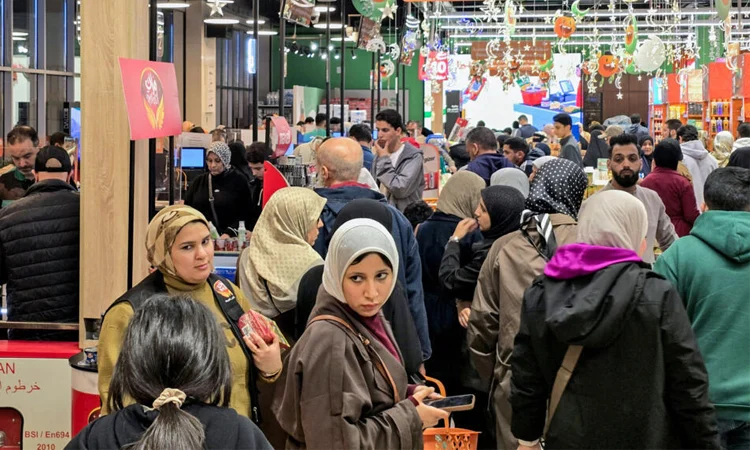
TRIPOLI, Feb 22, 2026 (BSS/AFP) – Libyans have been celebrating Ramadan with banquets and fireworks, but prices are soaring, the dinar is devalued, and the country is divided, leaving little to celebrate.
Fifteen years after the overthrow of longtime leader Muammar Gaddafi, the country remains divided between east and west, while the lack of basic goods such as fuel is disrupting life in the country, despite the fact that Libya has huge reserves of oil and gas.
In the Muslim holy month of Ramadan, people go on a shopping spree for goodies, as families come together for sumptuous meals before and after the day-long fasting from sunrise to sunset.
However, this Ramadan, the country’s supermarkets have been limiting the amount of goods sold to customers, while petrol stations are running low on fuel. In the capital Tripoli, most of the country’s ATMs are empty.
“It’s true that the economy is deteriorating,” said 37-year-old Firas Zreeg, as he navigated through a crowded supermarket. “This is due to speculators who are selling the dinar at a low price, which has negative repercussions on our daily lives,” he told AFP.
The price of cooking oil has doubled in the past few weeks, while the price of meat and poultry products has gone up by 50 percent.
Refills of gas cylinders, which are officially priced at 1.5 dinars (24 cents) but are not always available from government-controlled distribution agencies, are now being sold for 75 dinars (11.85 dollars) on the black market and sometimes for even higher prices.
‘Burden on citizens’ –
Libya has struggled to move past the turmoil that broke out in the wake of the 2011 Arab Spring uprising that overthrew Gaddafi.
It remains split between a UN-recognized government in Tripoli and an administration in the east led by military leader Khalifa Haftar.
The country has been relatively stable in recent years, although there have been periods of violent clashes, including the death of Gaddafi’s son and heir apparent Seif al-Islam this month.
With security in place, many Libyans are more concerned about their daily lives.
Last month, the central bank in the western territory devalued the dinar, the country’s currency, for the second time in less than a year, by almost 15 percent, “to preserve financial and monetary stability and to ensure the sustainability of public resources.”
In a speech this week, Prime Minister Abdulhamid Dbeibah admitted that the devaluation has again placed the “burden on citizens”.
Hanna Tetteh, the head of the United Nations Support Mission in Libya, said on Wednesday that “poverty and pressure on society [are] increasing”.
Libya Faces Fragile Security and Rising Economic Challenges, UN Told
“The situation, in addition to the fragile security landscape, should be a matter for concern as such conditions can lead to unexpected political and security challenges,” she told the UN Security Council.
Other economic issues in Libya included the lack of a national budget, in view of the country’s political division, as well as uncoordinated public spending because of the parallel state institutions, Tetteh explained.
Oil Revenues Decline as Libya Struggles With Political Division
The revenues from the oil sector are also dwindling, she said, while the central bank has reported that public spending is increasing at an unsustainable rate.
On Tuesday, Libya celebrated 15 years since the beginning of the uprising that led to the fall of Gaddafi, with fireworks lighting up the night sky in Tripoli, but for most Libyans, life is still a struggle.
“Minor security gains have been achieved over the last three years,” Zreeg told Agence France-Presse (AFP), but he added that despite the fact that some areas have seen a relative decrease in armed clashes and that checkpoints are now better organized, the situation is still precarious. He also said that despite the fact that some stability has been restored in some parts of the country, the lives of ordinary people have not improved much.
In his assessment, Zreeg said that Libyans are still facing huge economic challenges, including inflation, unemployment, delayed payment of salaries, and power outages. Many Libyan families are having difficulty affording basic needs because of the lack of consistency in public services and the slow pace of infrastructure projects. He said that without political unity and economic reforms, the small security gains that have been made in the past years may not lead to improvements in the lives of the people.