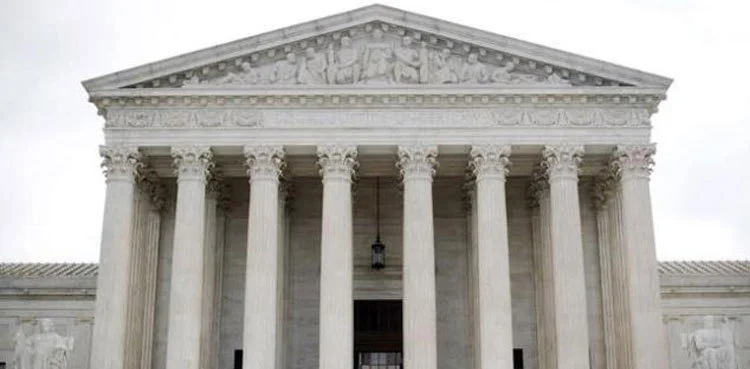
The US Supreme Court ruled Friday that Donald Trump exceeded his authority in imposing a swath of tariffs that upended global trade, blocking a key tool the president has wielded to impose his economic agenda.
The conservative-majority Supreme Court issued a six-three decision.. It stated that the International Emergency Economic Powers Act (IEEPA) “does not authorize the President to impose tariffs..”
Trump has long used tariffs to apply pressure and negotiate.. Since returning to office last year, he actively invoked emergency economic powers to impose new tariffs on all US trading partners..
These tariffs included “reciprocal” tariffs on trade practices deemed unfair by the US government.. They also targeted Mexico, Canada, and China over drug smuggling and immigration issues..
The Supreme Court said Friday that “had Congress intended to convey the distinct and extraordinary power to impose tariffs” through IEEPA, “it would have done so expressly, as it consistently has in other tariff statutes..”
The decision does not affect sector-specific tariffs that Trump has imposed on imports of steel, aluminum, and other goods.
Several government investigations that could result in further tariffs on specific sectors are still in the pipeline.
The Supreme Court’s three liberal justices sided with three conservatives on Friday’s ruling, which affirmed the lower court’s rulings that the tariffs Trump imposed were illegal under IEEPA.
Justices Brett Kavanaugh, Clarence Thomas, and Samuel Alito dissented.
Chief Justice John Roberts, in his opinion, said that “IEEPA contains no reference to tariffs or duties.”
Lower court blocks Trump’s tariffs.. Average rates set to drop.. Potential revenue losses loom.
In May, a lower trade court ruled that Trump overstepped his authority with his blanket tariffs.. The court blocked most from taking effect.. The government appealed, keeping the decision on hold..
The striking down of the tariffs will lower the average tariff rate from 16.8 percent to 9.5 percent.. EY-Parthenon Chief Economist Gregory Daco told AFP this before the ruling..
However, this may be only a short-term reprieve.. The government may seek other ways to reinstate broad tariffs..
Tariff revenues are also at risk.. Daco estimated that blocking the tariffs could cost the government $100 billion to $120 billion…
The justices did not rule on the extent to which importers are entitled to refunds.
However, Kavanaugh cautioned that this procedure, as has been acknowledged in the oral arguments, could be a “mess.”
The striking down of the emergency tariffs “would limit the president’s plans to impose tariffs across the board on a whim,” said Erica York of the Tax Foundation, a tax policy organization.
However, this does not mean that he does not have other laws to draw from in imposing tariffs, even if these laws are narrower in scope or subject to certain procedures such as investigations, York told AFP.